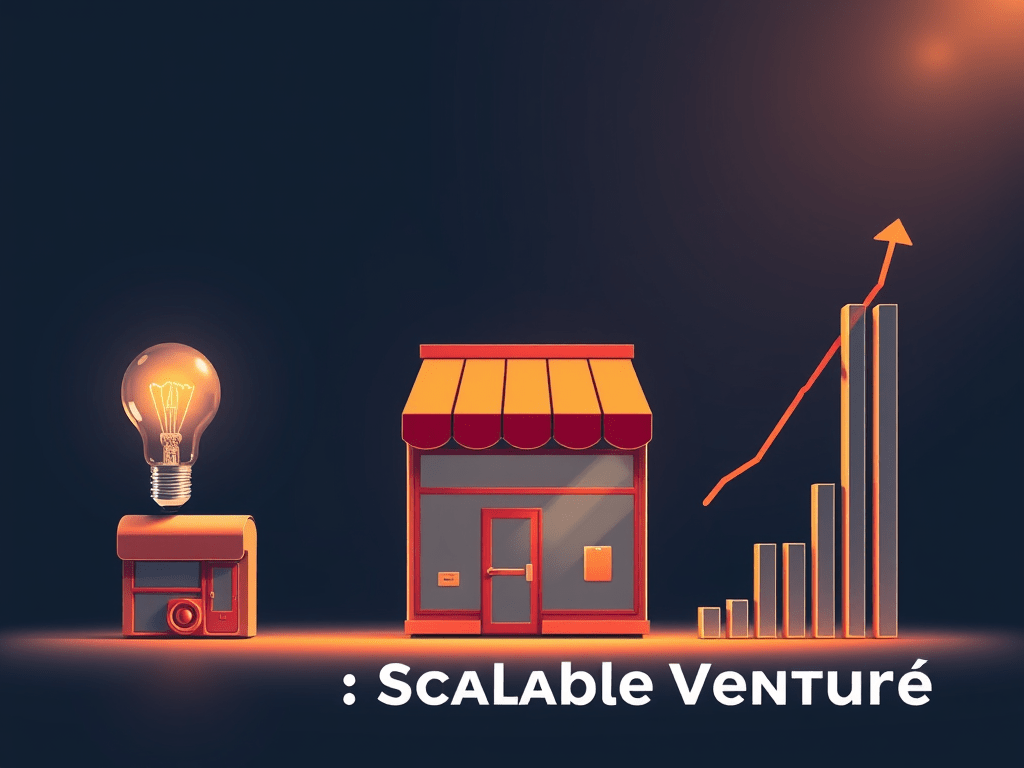
Founders often speak as if these three are interchangeable.
They are not.
Understanding the distinction early prevents strategic confusion later.
1. An Idea
An idea is a hypothesis:
“If we build X, then Y will happen.”
Ideas are cheap, abundant, and unvalidated.
They carry no obligation to reality.
Most founders fall in love here—and stay too long.
2. A Business
A business exists when:
- A specific customer pays
- For a specific outcome
- Through a repeatable mechanism
At this stage, elegance matters less than reliability.
A business does not need scale—it needs consistency.
Many profitable businesses never become ventures.
That is not a failure. It is a choice.
3. A Scalable Venture
A venture is a business with:
- Non-linear growth potential
- Structural leverage (technology, network effects, capital efficiency)
- A market large enough to justify acceleration
Not all businesses should scale.
Scaling prematurely amplifies inefficiency and fragility.
The Founder’s Strategic Error
The most common mistake is designing as if one is building a venture, while operating as if one is still validating an idea.
This leads to:
- Over-engineering
- Premature hiring
- Artificial growth targets
- Burn disguised as momentum
A disciplined founder asks, repeatedly:
“What am I building right now—an idea, a business, or a venture?”
The answer determines every decision downstream.
 Entrepreneur Edge
Leave a comment